
From Classroom to Consultant: How SAP Certification Bridges the Experience Gap
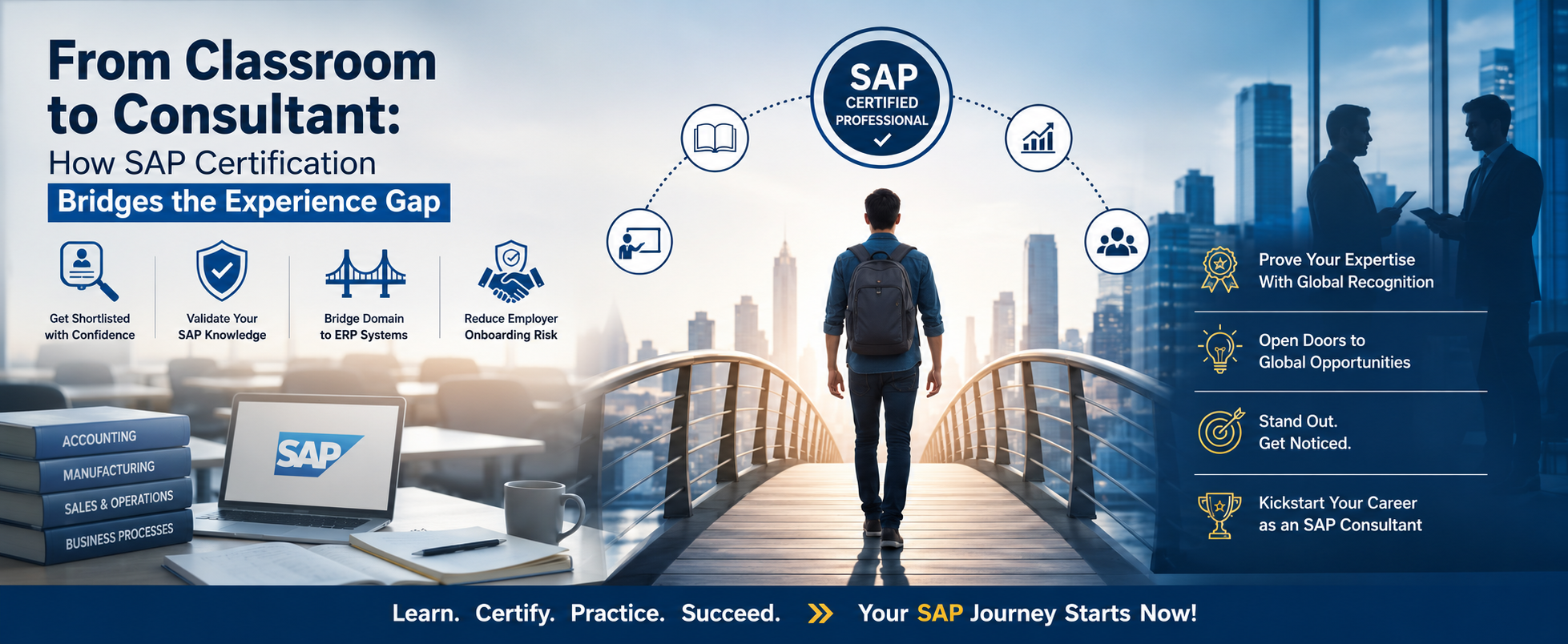
Entering the SAP ecosystem as a newcomer can feel like trying to break into a locked room—most employers aggressively seek professionals with "prior project experience". This creates a classic catch-22: How do you get experience if no one will hire you without it?
This is where official SAP Certification acts as a powerful catalyst. While it is not a "magic passport" that guarantees a job overnight, it systematically lowers the barrier to entry for freshers and transitioning professionals in several key ways:
1. Overcoming the "Screening Filter" (Shortlisting Advantage)
When IT consultancies, global service providers (like Accenture, TCS, or Capgemini), and end- user enterprises post junior or associate SAP roles, they are flooded with hundreds of resumes.
- The Filter:
- The Impact:
HR departments and automated recruitment software frequently use "SAP Certified"; as a primary filtering keyword.
Holding an official certification vastly increases your chances of getting your resume shortlisted and advancing to introductory screening calls.
2. Standardizing and Validating Your Knowledge
Without prior project work on your resume, employers have no way of knowing if you actually understand the software.
- Global Benchmark:
- System Competency:
SAP’s global certification exams are standardized. Passing one proves to an employer that you have achieved a verified benchmark of proficiency in a specific module (such as S/4HANA FICO, MM, SD, or ABAP).
It indicates you know the standard database schemas, structural tables, and configuration protocols, saving the hiring company significant basic training time.
3. Bridging Domain Experience to ERP Systems
If you are transitioning from a non-IT field—such as accounting, manufacturing, or sales—certification acts as the formal bridge.
-
An accountant who gets certified in SAP FICO immediately transforms their generic financial background into highly specialized "financial systems design" expertise.
-
A mechanical or production engineer certified in SAP MM bridges the gap between physical factory floor operations and digital procurement software.
4. Reducing the Employer's "Onboarding Risk"
Hiring an untrained, uncertified newcomer is a major financial risk for an enterprise. They might configure a live system incorrectly, resulting in database discrepancies.
-
Certification proves a candidate's high level of professional commitment, structured training, and baseline technological safety.
-
It assures the client-facing consulting team that you can be placed in a junior supporting role (like system testing or end-user support) with minimal hand-holding.
⚠️ The Reality Check: Certification + Practicality
To be highly competitive, candidates must understand that certification alone is only half the battle. To successfully transition certification into a job offer, freshers must pair their credentials with:
- Practical Project Knowledge:
- Strong Business Process Understanding:
- Soft Skills:
You must be able to talk about dummy projects, sandbox system setups, or case-study business scenarios during interviews.
You need to understand why a company runs a process, not just which transaction code to click.
Skills: Analytical thinking, effective communication, and problem-solving skills are what ultimately close the deal in consulting rounds.